全职妈妈
淘宝买的小米扫地机器人有质量问题还遭平台拒退,处理太不负责_我的网站

一 |
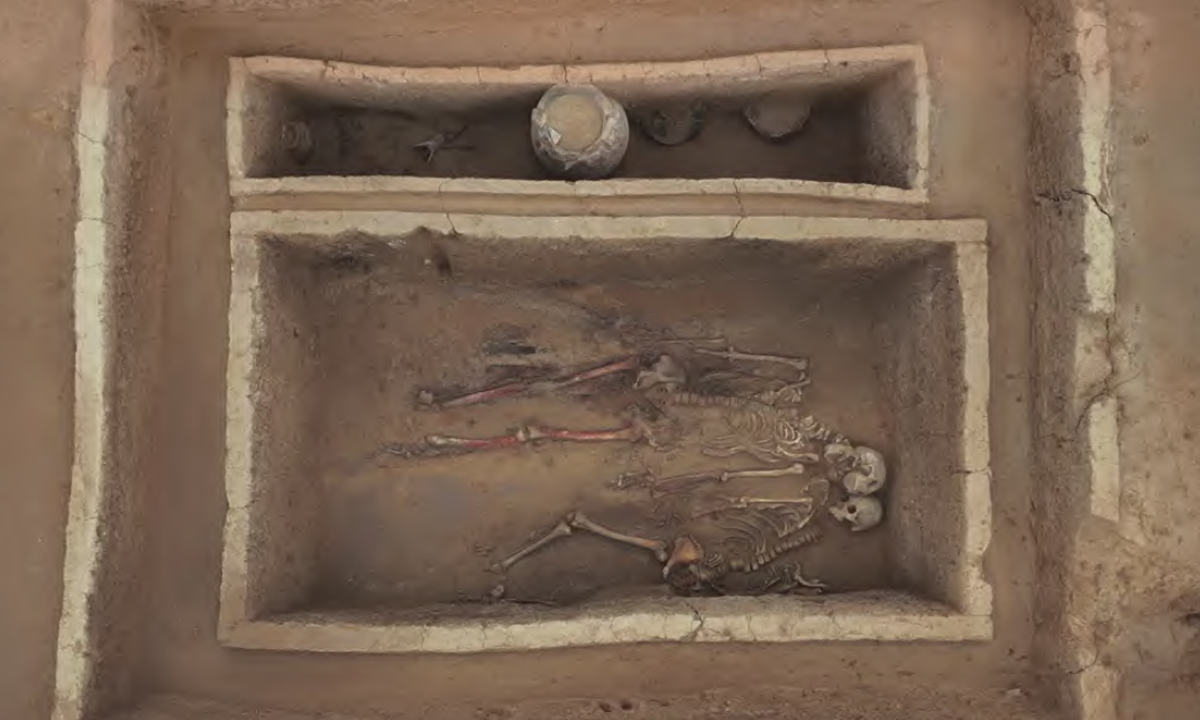
Located on a hilly terrace west of the Taihang Mountains and flanked by the Songxi River, the site was excavated in 2024 and 2025 by the Shanxi Provincial Institute of Archaeology and partner institutions, leading to the discovery of 18 tombs, including six Xia Dynasty burial sites and 12 Warring States Period (475BC-221BC) graves.
"These are the highest-ranking Xia aristocratic tombs discovered so far, indicating that this location was a regional center," the institute said.
The Xia Dynasty is traditionally regarded as China's first hereditary dynasty, though contemporaneous written records are lacking.
The well-organized Xia tombs, concentrated in the western part of the cemetery, feature uniform east-west oriented vertical earthen pits. Researchers recovered nearly 40 sets of artifacts with distinctive local cultural characteristics, including pottery, lacquerware and turquoise ornaments.
Extended regional surveys across the Songxi River valley yielded more than 10 Xia and Shang period sites. Test excavations at nearby relic sites unearthed pottery fragments, stone tools, bronze knives, as well as tin-bronze ingots and smelting residue, providing solid evidence of early metal mining and craftsmanship.
Local copper-iron symbiotic ore deposits confirm exploitation of these resources during the Xia and Shang eras, while typical cultural artifacts found in adjacent counties reveal widespread regional cultural exchange.
Multidisciplinary analyses further decoded the civilization's features. Ancient human remains belong primarily to the ancient population of the Central Plains with minor Mongolian Plateau genetic traits, forming a stable patrilineal clan. The community relied on millet farming and maintained long-distance resource trade networks.
Artifact provenance tests trace scallop shell ornaments to the Bohai Sea, cinnabar to Hunan-Guizhou ore belts, turquoise to the eastern Qinling Mountains area, and coffin timber to local Taihang pine trees. Such diverse materials reflect close interaction among the Taihang foothills, the press release noted.
Lab restoration unveiled refined ritual relics, including a dragon-patterned lacquer cylinder with red and black stripes and an intact lacquer gu vessel (a type of wine vessel). Turquoise plaques from the site match specimens from the Erlitou site, a core Xia cultural relic, proving cross-regional cultural interaction. Radiocarbon dating places the site's active period between 1880BC and 1450BC, aligning with the late Xia Dynasty.
Scholars confirmed the findings have helped reshape academic understanding of Xia-Shang civilizations and reconstruct multi-level settlement patterns on the western Taihang foothills, while offering new insights into social complexity and civilization development in early China.
。 我于2026年7月18日购买小米扫地机器人6,货到之后使用仅未超过一个月商品降价31%询问官方客服告知是淘宝平台问题,找了淘宝平台说是计算问题后不了了之。8月17日我发现机器人垃圾集尘处堵塞,第一时间询问小米官方旗舰店客服解决办法,告知需要用手掏,但是问题是吸的毛发已经硬了抠不出来(平常仅用于除尘及吸毛)然后...。

二 |
Current article:http://o7te0iv.miaorediancuisuilianzouguang.cyou/news/20260826_93987.html
Published on:12:13:39
 情事
情事 血战太平洋
血战太平洋 永不磨灭的番号
 爱情公寓3
爱情公寓3 生化危机
生化危机 新白娘子传奇
 我型我秀
我型我秀 河神
河神


